

Speaker: Dr. William A. Ambrose
Company: UT-BEG Senior Research Scientist (Retired)
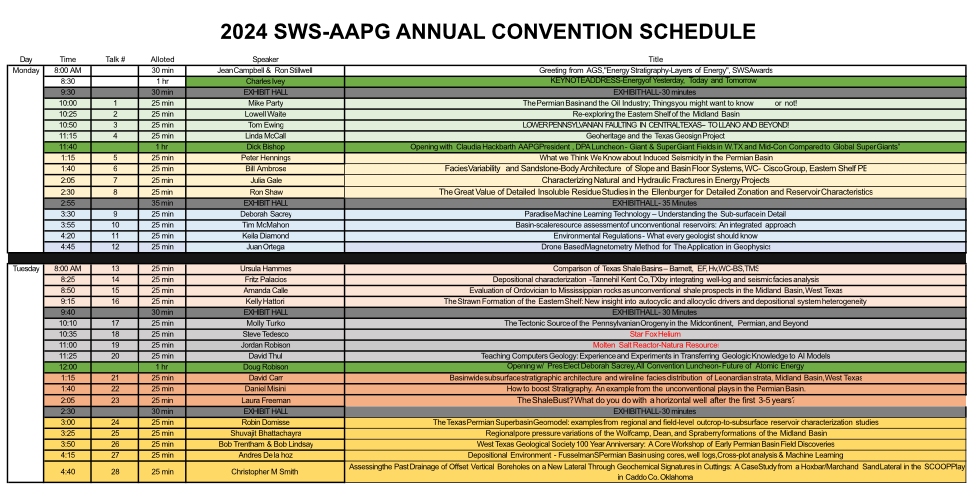
Presentation: “Valley-Fill, Estuarine, and Deltaic Deposits in the Tannehill Sandstone (Cisco Group), Eastern Shelf of the Permian Basin
Valley-Fill, Estuarine, and Deltaic Deposits in the Tannehill Sandstone (Cisco Group), Eastern Shelf of the Permian Basin
William A. Ambrose, Tucker F. Hentz, Harold Rogers, and David L. Carr
ABSTRACT
Lowstand valley-fill and shelf-edge deltaic deposits in the Tannehill Sandstone (Wolfcampian Cisco Group) in the Eastern Shelf of the Permian Basin are major targets for oil and gas exploration. The most-productive trends link coarse-grained alluvial systems in Baylor County to shelf-edge and upper-slope deepwater systems in Dickens County. Depositional axes in the Tannehill Sandstone in the updip (eastern) facies tract in Wichita, Archer, Clay, and Montague Counties, proximal to sediment source areas in the Ouachita fold belt and the Arbuckle Mountains, contain 40 to 80 ft (12 to 24.4 m) of net sandstone in complex and anastomosing patterns that record coarse-grained, braided channel systems. Tannehill fluvial depositional axes west of the outcrop belt and east of the Saddle Creek shelf edge are confined to narrow, (2- to 5-mi [<3.2 to 8.0-km]), moderately sinuous belts with 10 to 40 ft (3 to 12 m) of net sandstone. These depositional axes represent two types of depositional systems. Depositional axes with tributary patterns that extend to the shelf edge are lowstand, incised-valley fill deposits. Cores in these incised-valley fill systems contain coarse-grained, fluvial-channel-fill sandstones in erosional contact with transgressive carbonate deposits. These channel-fill sandstones grade upward into muddy, abandoned-channel fill and floodplain deposits with paleosols, in turn overlain by nonporous, transgressive carbonates that record marine flooding of the Tannehill valley-fill succession. A second trend of depositional axes between the outcrop belt and the Saddle Creek shelf edge displays westward-bifurcating net-sandstone patterns, many of which terminate east of the shelf edge. These net-sandstone patterns represent slightly younger, highstand deltaic deposits.
Tannehill valley-fill systems along the eastern margin of the Saddle Creek shelf edge are dominated by estuarine deposits. Tannehill estuarine sandstones in western King County, approximately 20 miles (~32 kilometers) east of the Saddle Creek shelf edge, contain tidal stratification consisting of bi-directional ripples and thin, millimeter-scale, and cyclic mudstone drapes. Tannehill estuarine deposits contain shallow-marine ichnofauna with Planolites, Schaubcylindrichnus, and Conichnus. The value of this study for oil and gas exploration in the Tannehill Sandstone is three-fold: it (1) extends previous work depicting the distribution of lowstand valley-fill and deltaic systems at both regional and local scales, (2) adds core control and provides interpretations of facies in non-marine, marginal-marine, and shallow-marine deposits, allowing reconstruction of the depositional history, and (3) provides an exploration framework and geologic context for the various Tannehill producing fields and trends, as well other areas in the Eastern Shelf with potential for additional oil and gas production.
Biography – William A. Ambrose
He was a principal investigator of the Bureau’s STARR (State of Texas Advanced Oil and Gas Resource Recovery) program, past president of the Energy Minerals Division (EMD) of AAPG, chair of the EMD Coal Committee, and co -chair of the AAPG Astrogeology Committee
Members and guests are welcome. Meal prices are $15 with or without a reservation but reservations are encouraged!

 AGS on Facebook
 AGS on LinkedIn